Keeping Agents Honest: Governance and Verification for AI-Built Software
The guardrails behind a practice where AI agents write most of the code: merge rights gated by risk, written bars for every automated control, and eval and verification suites that state plainly what they do not check yet.
- When
- 2026-02 – now
- Role
- Designed and directed · built with Claude Code
- For
- Lightcone Studios
- Facts
- 9 verified
Facts
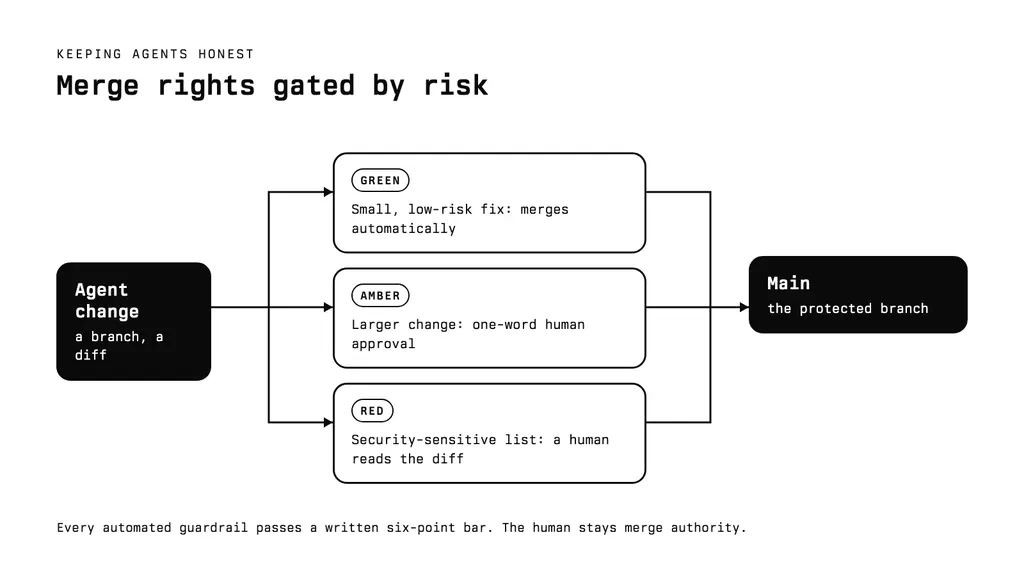
- Three merge rails gate what agents can ship: automatic for small low-risk fixes, a one-word human approval for larger changes, and a human who reads the diff for anything on a security-sensitive listprivate document · checked 2026-10-03
- A concept-of-operations document codifies human-in-the-loop rules for agents on sensitive data: recommend only, show the diff before any write, confirm before writingprivate document · checked 2026-10-03
- Every automated guardrail must pass a written six-point bar, including a 300 ms budget, nudge-not-block behavior and logged bypassesprivate document · checked 2026-10-03
- A versioned human-agent collaboration contract (v1.1, six disciplines) keeps the human as merge authorityprivate document · checked 2026-10-03
- A behavioral eval suite for agent modes: 23 cases across 4 modes, with anti-fabrication assertions; its structural checks run in CIprivate repo · checked 2026-10-03
- Not built yet: LLM-in-the-loop scoring of those evalsprivate repo · checked 2026-10-03
- A verification matrix traces 50 rules to their verifying tests; 13 are still marked unverified and routed for workprivate document · checked 2026-10-03
- 100 automated tests in CI since June 2026, including 31 privacy-boundary tests written after a real bugprivate measurement · checked 2026-10-03
- Supply-chain CI: known-vulnerability scans, OpenSSF Scorecard, and a 7-day cooldown before new packages are adoptedprivate repo · checked 2026-10-03